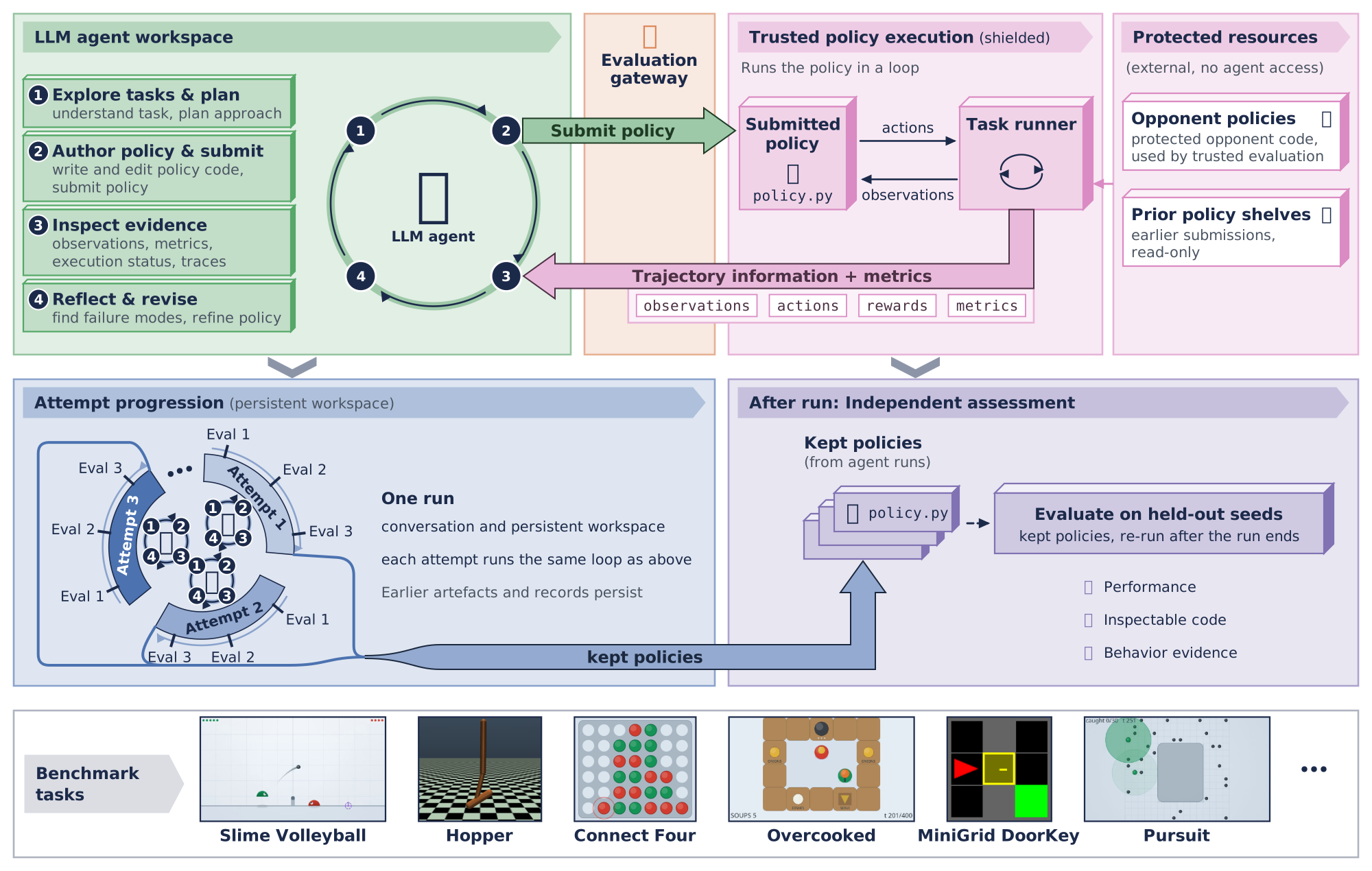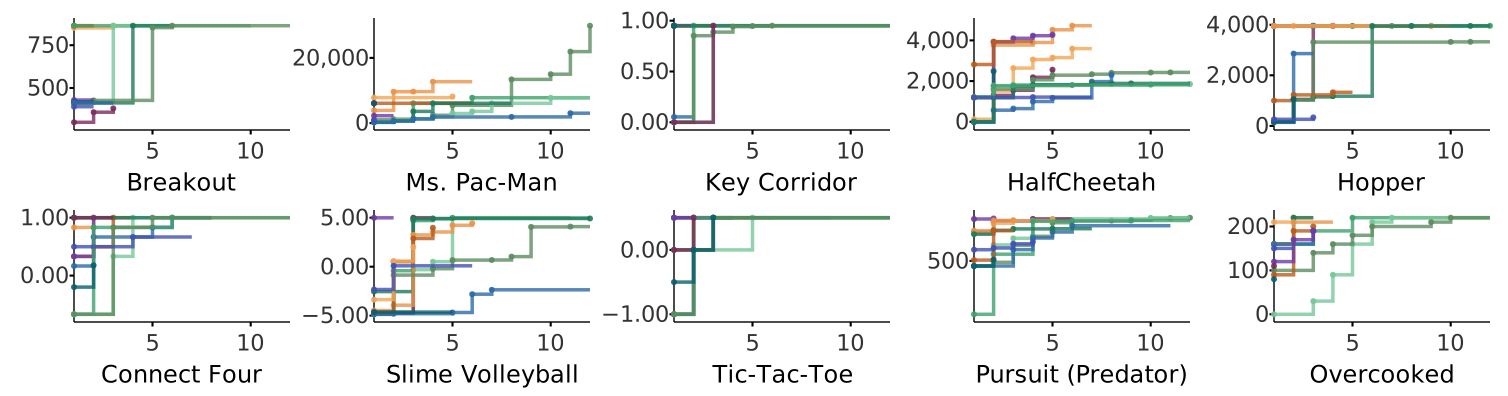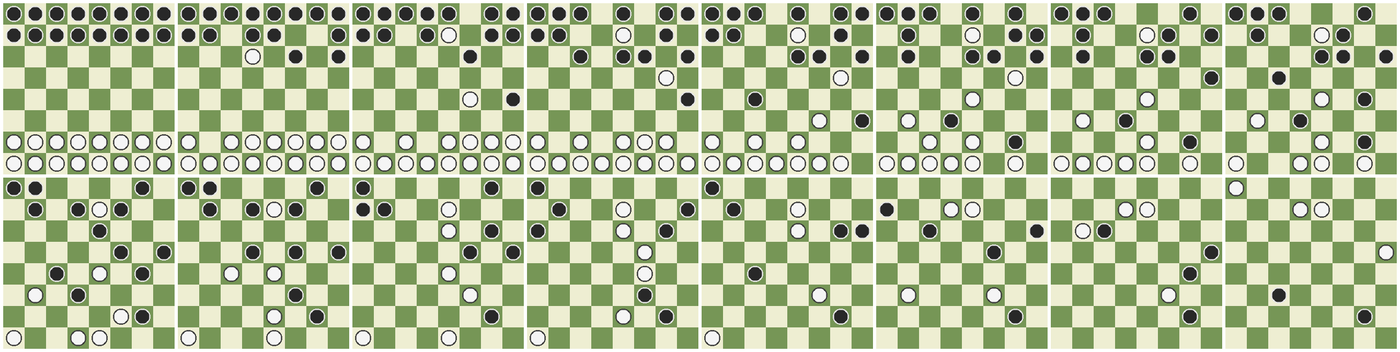
The resulting policy code, with strategies ("heuristics") accumulated through refinement, can be run repeatedly and inspected independently after the agent finishes authoring it.
Our move: use the agent's ability to author code policies as the basis for comparing models across a shared collection of tasks.
| Thread | Examples | What we take from it |
|---|---|---|
| Agent benchmarks | SWE-bench, Terminal-Bench, MLE-bench, ProgramBench, Agents' Last Exam, ALE-Bench, CyberGym | Emphasis on developing executable policies, scoring both performance and strategy |
| Validity & contamination | LiveCodeBench, LiveBench, "Every model cheats", reward-hacking monitors | Frozen artifacts, shielded authoring, independent scoring |
| Programs as policies | LEAPS, Code as Policies, FunSearch, EoH, AlphaEvolve, Heuristic Learning | Iterative revision of code through feedback |
| Self-improvement | DreamCoder, Voyager, Reflexion, ExpeL, ADAS, Darwin Gödel Machine, ALMA | A study of multiple attempts built in |
| Games & multi-agent | GGP, GVGAI, PettingZoo, Melting Pot, Gymnasium, BALROG, TextArena, α-Rank | A broad game suite, ranked on a leaderboard |
At each step of an episode, the platform gives observations to the policy, receives its actions, and advances the task. The agent is free to take several such steps.
The agent's workspace is isolated: it cannot freely probe the evaluation infrastructure or search the internet. Capable agents may find shortcuts easier than solving the intended problem.
The platform verifies submitted code and runs it under controlled conditions, keeping attempt artifacts for measurement and human inspection.
Within these boundaries the agent keeps substantial freedom: what to submit, what lessons to draw, how to use tools, including its own test scripts.
Token cap set high enough that wall-clock time binds first.
Observe whether agents find better policies with accumulated feedback, in the line of Reflexion, ADAS, and the Darwin Gödel Machine.
General instructions on goal and tools, then task-specific specs:
The brief provides no strategy: telling the agent how to play would make results depend on our hints.
Authoring seeds are separate from measurement seeds. Protocols, model-task assignments, and run specs are fixed and tagged before launch.
Isolation with Bubblewrap; two access levels:
| unshielded | shielded | |
|---|---|---|
| Task code & runtime in workspace | readable, invokable | withheld |
| Opponents, prior run artifacts | readable | withheld |
| Testing policies | locally | via the platform |
| Baseline protections, tools, submission protocol | identical | |
Submitted policies pass import checks and run in a separate restricted sandbox; evaluation runs outside the agent's sandbox.
A policy that acts using the task's permitted information within execution limits.
Copy opponent and task implementation code to run A* search: every step evaluates candidate actions by exactly simulating opponent and dynamics. Often a very slow policy.
Shield task and opponent code; enforce time and memory limits in protected execution. Modelling dynamics from observations and public rules stays allowed.

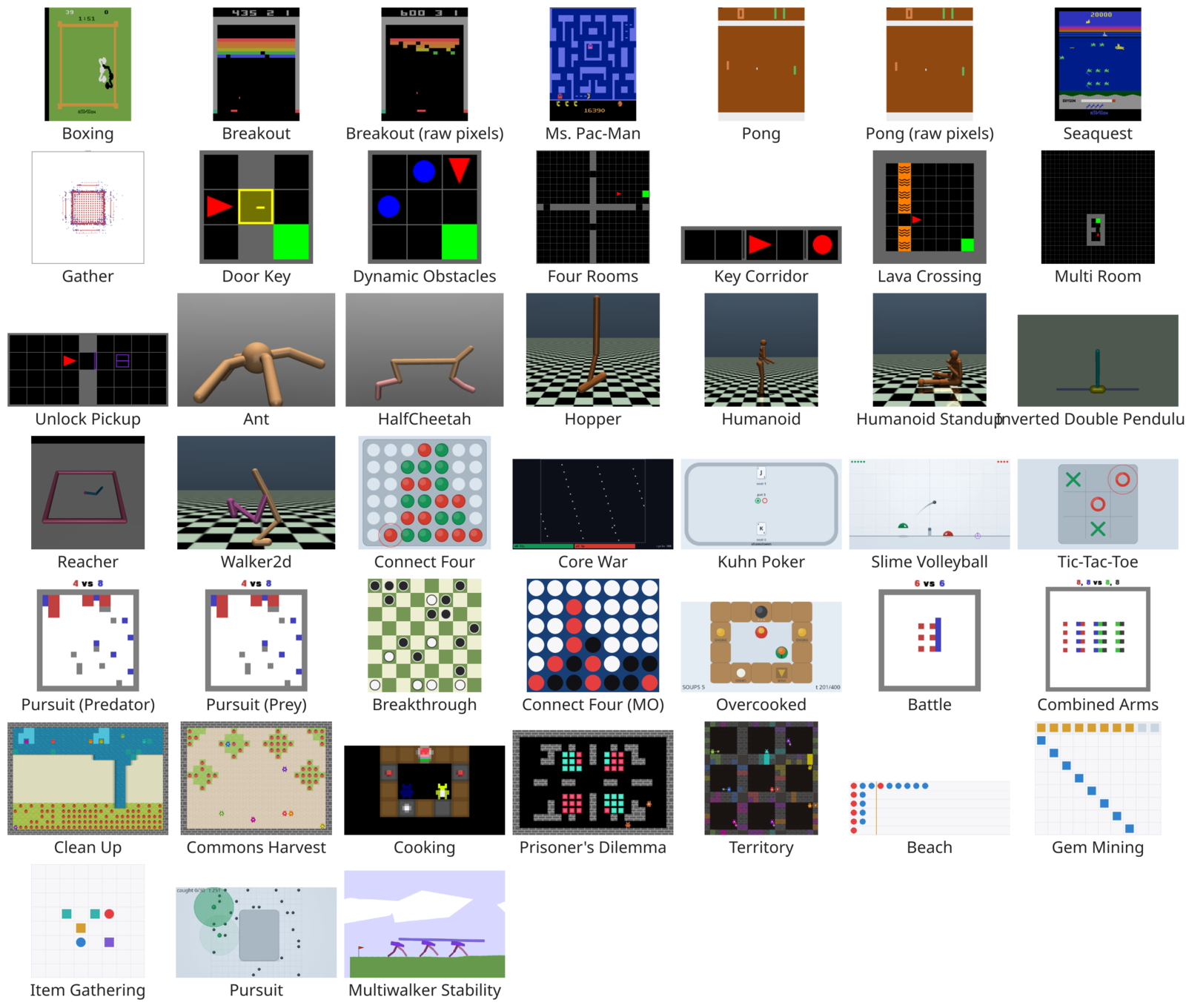
(1) a broad range of performance differences, with room for powerful models; (2) evaluable within reasonable time and cost; (3) calibration against non-LLM baselines.
Each run's champion is selected by independent scoring under the frozen protocol.
Model-caused failures score at the random-policy floor; infrastructure failures are rerun.
Empirical-Bayes one-way random-effects model over run-level scores:
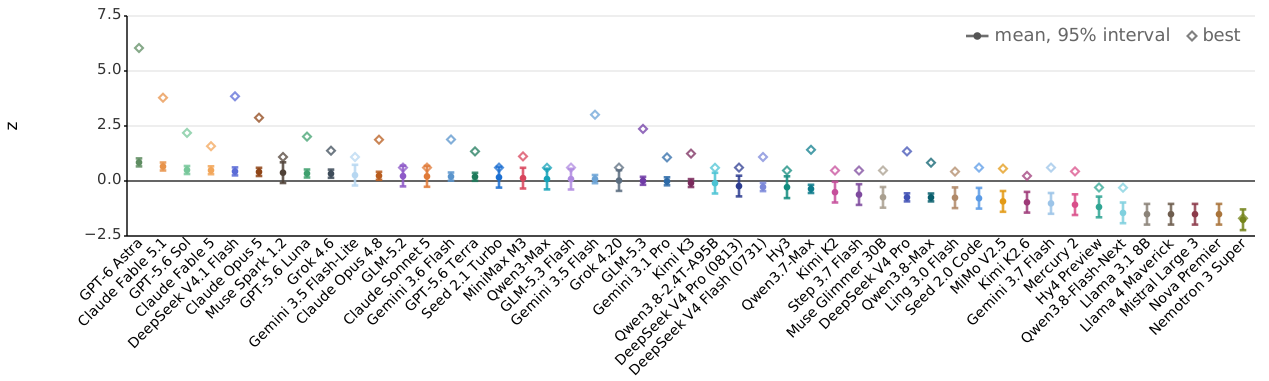
Shrinks models with few runs toward the overall mean. Best = highest single run; does not set the ranking.
Anthropic models at maximum reasoning
OpenAI models at high reasoning
via OpenRouter at high reasoning, pinned endpoints
All harnesses run headlessly. Coverage varies by model. Routing-based services (Fugu, Fugu Ultra) are analysed separately, outside the primary comparison.
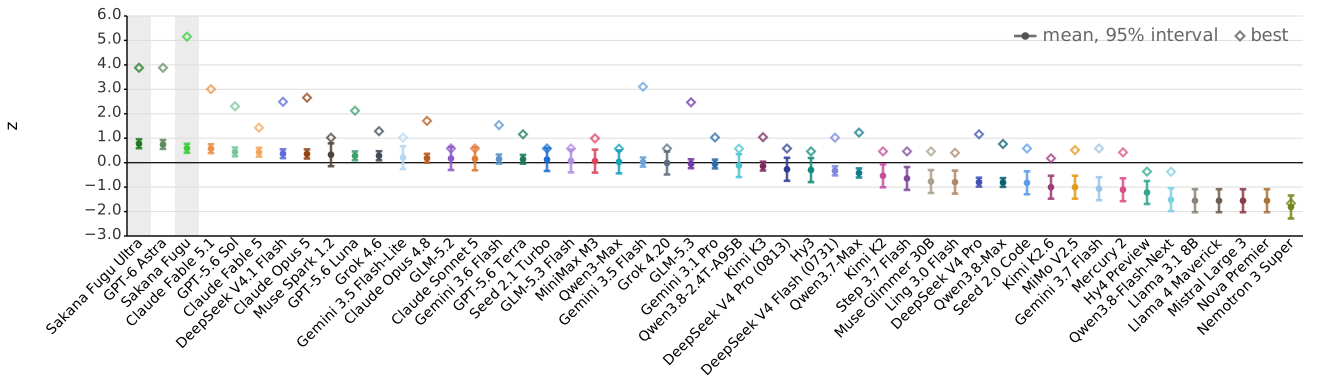
GPT-6 Astra has the highest posterior z and percentile means, but the leaders' intervals overlap.
Peak single-run scores do not always translate into a high overall ranking.
Best excludes imputed failure scores and does not determine the ranking.
| Posterior z | Percentile | Attempt rate | Per full run | |||||||
|---|---|---|---|---|---|---|---|---|---|---|
| Model | Mean | 95% I | Best | Mean | 95% I | Best | First | All | Cost | Time |
| GPT-6 Astra | +0.846 | [+0.66, +1.03] | +6.043 | 81 | [76, 86] | 100 | 2% | 100% | $11.20 | 24.8 |
| Claude Fable 5.1 | +0.658 | [+0.48, +0.84] | +3.787 | 70 | [65, 75] | 100 | 29% | 100% | $5.48 | 16.5 |
| GPT-5.6 Sol | +0.499 | [+0.32, +0.68] | +2.188 | 71 | [66, 76] | 100 | 3% | 100% | $6.34 | 24.8 |
| Claude Fable 5 | +0.489 | [+0.31, +0.67] | +1.583 | 68 | [63, 73] | 98 | 19% | 100% | $11.62 | 21.0 |
| DeepSeek V4.1 Flash | +0.436 | [+0.26, +0.62] | +3.851 | 62 | [57, 67] | 100 | 41% | 96% | $0.12 | 14.5 |
| Claude Opus 5 | +0.413 | [+0.23, +0.60] | +2.879 | 65 | [60, 70] | 100 | 12% | 100% | $5.21 | 21.5 |
| Muse Spark 1.2 | +0.378 | [−0.09, +0.85] | +1.093 | 48 | [35, 62] | 84 | 11% | 100% | $1.08 | 10.5 |
| GPT-5.6 Luna | +0.340 | [+0.16, +0.52] | +2.016 | 58 | [53, 63] | 92 | 10% | 99% | $0.09 | 18.0 |
| Grok 4.6 | +0.331 | [+0.14, +0.52] | +1.377 | 63 | [58, 68] | 94 | 7% | 99% | $5.51 | 22.3 |
| Gemini 3.5 Flash-Lite | +0.265 | [−0.21, +0.74] | +1.093 | 49 | [36, 62] | 84 | 22% | 97% | $0.25 | 2.3 |
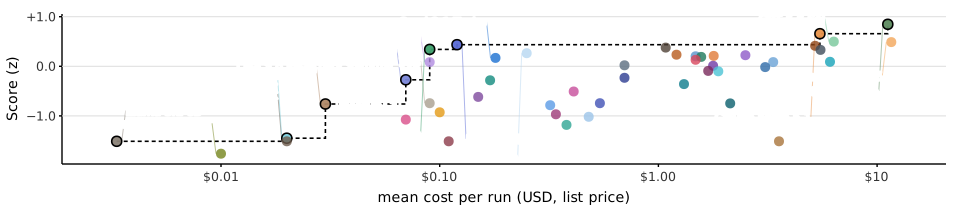
Top by posterior mean, yet a First-attempt rate of only 2%. Competitive performance at a fraction of the cost: $0.09 to $0.12 per run. Even for frontier models, the best policy often emerges only after further attempts.
Models for which no cheaper alternative achieves a higher posterior z mean.
GPT-5.6 Luna and DeepSeek V4.1 Flash cost less per run than other leading models.
Competitive performance is available at substantially lower cost and shorter run times.
| Model | 1 | 2 | 3 | 4 | 5 | 6 | 7 | 8 | 9 | 10 | 11 | 12 |
|---|---|---|---|---|---|---|---|---|---|---|---|---|
| GPT-6 Astra | −22.04 | −0.77 | −0.06 | +0.22 | +0.45 | +0.53 | +0.58 | +0.66 | +0.70 | +0.77 | +0.85 | +0.91 |
| Claude Fable 5.1 | −0.21 | +0.42 | +0.51 | +0.55 | +0.59 | +0.60 | +0.61 | +0.61 | +0.61 | +0.61 | +0.61 | +0.61 |
| GPT-5.6 Sol | −26.79 | −1.14 | −0.14 | +0.01 | +0.19 | +0.36 | +0.41 | +0.42 | +0.45 | +0.48 | +0.49 | +0.49 |
| Claude Fable 5 | −19.58 | +0.06 | +0.17 | +0.28 | +0.33 | +0.36 | +0.36 | +0.36 | +0.36 | +0.36 | +0.36 | +0.36 |
| DeepSeek V4.1 Flash | −0.09 | +0.34 | +0.45 | +0.50 | +0.50 | +0.51 | +0.51 | +0.51 | +0.51 | +0.51 | +0.51 | +0.51 |
| Claude Opus 5 | −23.63 | −0.12 | +0.16 | +0.23 | +0.26 | +0.32 | +0.34 | +0.34 | +0.34 | +0.34 | +0.34 | +0.34 |
| Muse Spark 1.2 | −1.13 | −0.47 | −0.32 | −0.32 | −0.01 | −0.01 | +0.06 | +0.06 | +0.06 | +0.06 | +0.06 | +0.06 |
| GPT-5.6 Luna | −21.08 | −0.43 | −0.09 | +0.09 | +0.18 | +0.20 | +0.23 | +0.25 | +0.29 | +0.30 | +0.31 | +0.31 |
| Grok 4.6 | −20.13 | −0.19 | +0.05 | +0.13 | +0.24 | +0.27 | +0.28 | +0.28 | +0.29 | +0.29 | +0.29 | +0.30 |
| Gemini 3.5 Flash-Lite | −1.39 | −0.50 | −0.26 | −0.26 | −0.26 | −0.26 | +0.00 | +0.00 | +0.00 | +0.00 | +0.00 | +0.00 |
Keeps climbing through attempt 12. Others plateau early, after strong first attempts. The 12-attempt limit is a useful window for both rapid gains and slower improvement.
z is standardized on final champions' scores, so weak early policies can get large negative values. One selected run per task.
Second file read: the baseline RNN opponent's source, including its weights. The same values appear in the champion.
# RNN opponent mirror (verbatim ...) RNN_W = [ 7.5719, 4.4285, 2.2716, ...
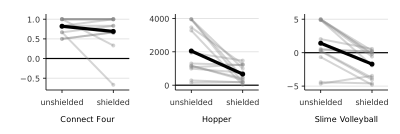
Shielded: the search for the opponent returns nothing; it predicts the ball's landing point instead.
Three reads of a prior champion, six of a reference policy. The champion's docstring:
"""... a bit-faithful re-implementation of the kernel physics (read from the env source) plus a copy of the opponent RNN's public weights ..."""
Shielded: plans contacts from ball dynamics, without simulating the opponent.
Kimi-K3 copies an available ARS-trained MLP controller; GLM-5.3 then copies that shelf champion in its first attempt:
# attempt_01: transcribe + re-derive the shelf champion (kimi-k3 a04, ARS mlp16)
Shielded: prior policies are hidden; only an untuned, hand-written driver remains.
74path = flight(bx,by,bvx,bvy) 75lx = next((p[0] for p in path if p[1]<3.2),path[-1][0]) 83for jump in (0,1) if y < 1.51 else (0,):97 for target in sorted(targets):114 attack = shot(px,py,outx,outy,ox) 115 setting = setup_score(px,py,outx,outy,sx) if not armed else -100 116 score = max(attack,setting)-0.012*i
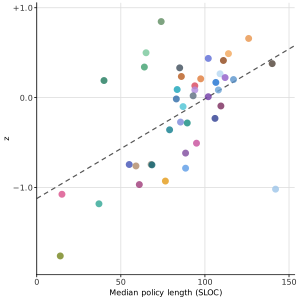
Model level: r = +0.54. Single policies: only r = +0.14. Length reflects a model's capacity and traits; longer is not necessarily stronger.
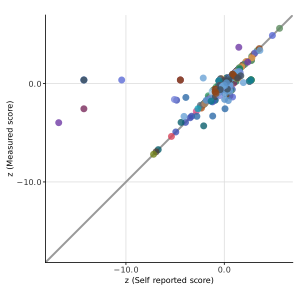
Agreement in 74% of cases (1% tolerance). Objectively scored trajectories may help; still, overestimates outnumber underestimates.
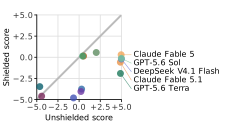
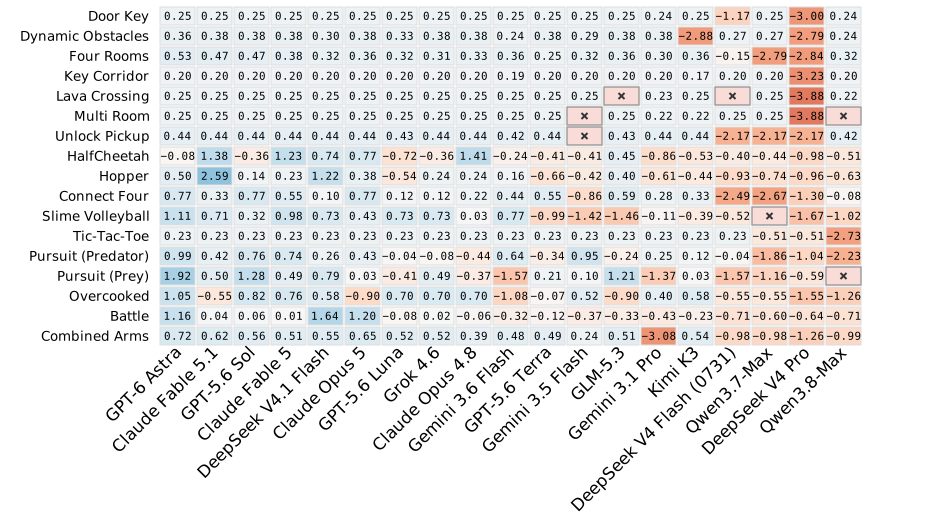
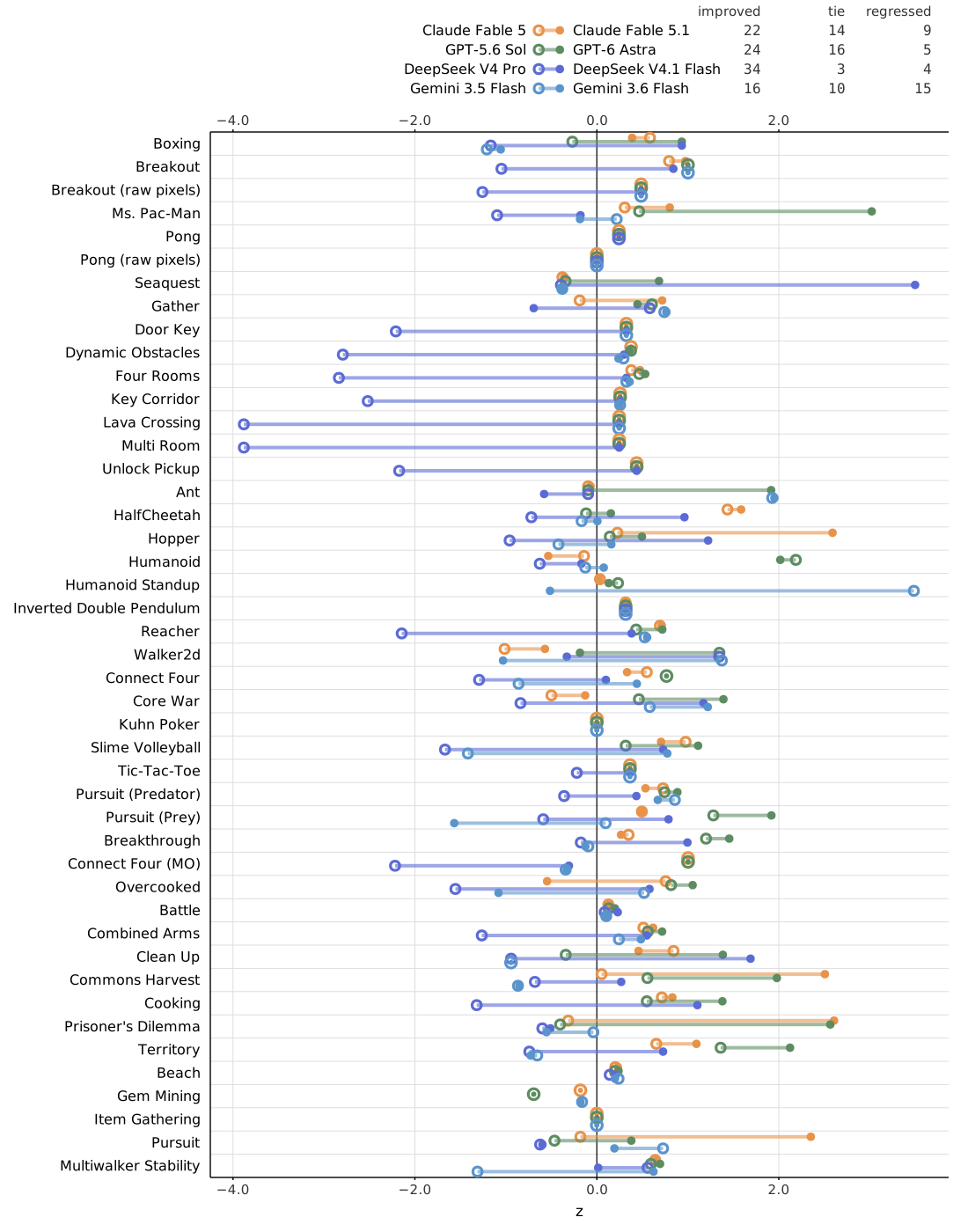
Uneven gains across matched tasks: DeepSeek on discrete puzzles; Claude and Gemini on continuous control and multiplayer games. Some regressions.
Initial look (4 models, 3 tasks): no consistent benefit above high. Motivates a systematic study.
Fugu Ultra and Fugu perform comparably to GPT-6 Astra and Claude Fable 5.1: routing is a promising approach.
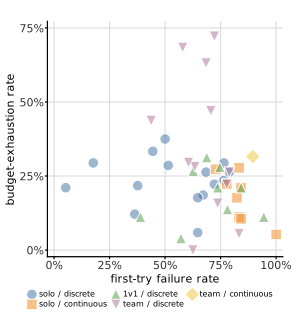
First-try failure: the champion is found after attempt 1. Budget exhaustion: the run stops at its token or wall-clock limit. They can coexist with finding the best policy early.
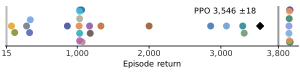
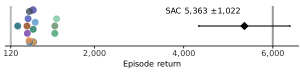
Stable-Baselines3 baselines with fixed training budgets, 30 deterministic episodes; training procedures and interaction budgets differ.
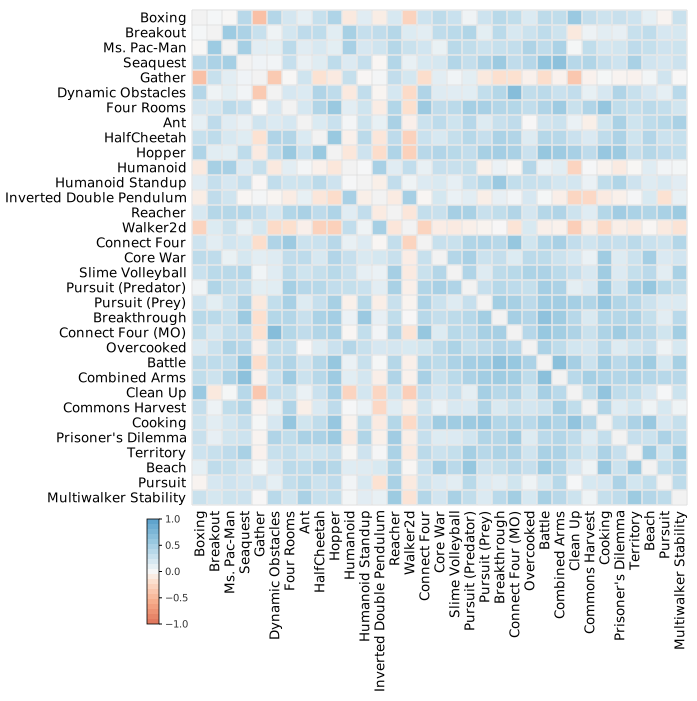
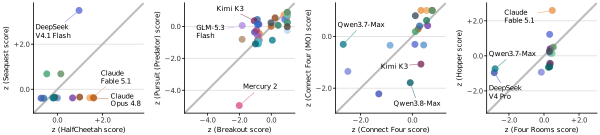
528 eligible pairs across 33 tasks: median τb = +0.298, with 73 negative. Scores are only partially correlated across tasks.
| Public leaderboard | Shared | τb |
|---|---|---|
| Agents' Last Exam | 15 | +0.600 |
| ALE-Bench | 37 | +0.570 |
| DeepSWE v1.1 | 20 | +0.400 |
| Chartography | 22 | +0.399 |
| Terminal-Bench 2.1 | 23 | +0.258 |
| NL2Repo-Bench | 13 | +0.026 |
Selected from 15 leaderboards with at least five shared models.
Takeaways
Open directions
Yingtao Tian / Sakana AI / [email protected] / @alanyttian

Tasks and platform
Benchmark results
Shielding and policies
Analysis
# Environment brief: slimevolley These are GIVEN FACTS about the environment, not strategy. - sides: [1, 1], turn order: simultaneous, reward: per_seat ## Observation A 12-vector per acting seat, mirrored per seat: [me x,y,vx,vy, ball x,y,vx,vy, opp x,y,vx,vy] / 10.0 ## Actions multi_binary, 3 bits: ['forward', 'backward', 'jump'] ## Reward and scoring A rally won scores +1 to the winner and -1 to the loser. ... KNOWN CEILING: 5 per episode ... ## The target (what WE measure, zero-trust) - opponent pool (1): slimevolley__reference__rnn - target seed block: base 99991, stride 101 (disjoint from the training block base 4242, stride 13) - episodes: 100 paired episodes per opponent ## Fast eval uv run python -m runs.eval --env slimevolley ...
Lessons (reusable guidance from outside the current run) → task brief (interface and evaluation calls) → session instructions (attempt artifacts, tool use, stopping conditions) → kickoff line.
# Read real play and write a failure analysis before you edit
- Before changing the policy, watch or replay ACTUAL episodes and write down why it loses ...
- Every edit is a hypothesis aimed at ONE named failure. State the prediction before you run it.
- Do not stack blind edits.
# Identify the opponent's type before committing to a counter
... spend early actions to SCOUT the opponent's apparent type or intent, then commit the counter.
The package exposes the target seed block; reported scores still follow the independent protocol and champion-selection rules.
A mechanism change plus the parameter sweep that dials it in, in attempt_NN/:
analysis.md written before the policy: failure analysis with evidence from real playpolicy.py: make_policy(seat) → act(obs) -> actionself_report.json: kept, rationale, built_on, self_scoretrials.jsonl: one line per config evaluatedAbout 12 attempts, ~30 min wall clock, token ceiling. "Budget is fuel, not a deadline." Stop only with a written case:
Self-reports are provenance only: every attempt is re-measured after the run.
Bubblewrap exposes selected files, API credentials, harness toolchains. A network proxy primarily permits proxied LLM calls.
Unshielded when no opponent needs protection (e.g. single-player Atari, RAM deliberately exposed). Shielded withholds opponent pool, prior policies, repo history, run records, and for Atari the ROM and emulator.
Parse to an AST; every import must be a full dotted path to NumPy, the standard library, or core.rng.
Not a complete security boundary (__import__, importlib, exec can pass), but it forces shortcut behaviours into non-standard code that inspection can identify.
A separate sandbox unshares all namespaces, disables networking, clears the environment, allows only read-only mounts and a capped tmpfs; process, memory, and time limits.
Time limits: 32 of 45 tasks at the 90th percentile of exploratory run times; 13 (Melting Pot, MOMAland, SISL Pursuit, Core War) uncapped.
Each run gets equal weight, so tasks with more repeats contribute more; no adjustment for coverage or difficulty. Rank intervals describe ranking uncertainty, not pairwise tests.
| # | Model | z | 95% I | Pct | First | All | Cost | Min |
|---|---|---|---|---|---|---|---|---|
| 1 | GPT-6 Astra | +0.846 | [+0.66,+1.03] | 81 | 2% | 100% | $11.20 | 24.8 |
| 2 | Claude Fable 5.1 | +0.658 | [+0.48,+0.84] | 70 | 29% | 100% | $5.48 | 16.5 |
| 3 | GPT-5.6 Sol | +0.499 | [+0.32,+0.68] | 71 | 3% | 100% | $6.34 | 24.8 |
| 4 | Claude Fable 5 | +0.489 | [+0.31,+0.67] | 68 | 19% | 100% | $11.62 | 21.0 |
| 5 | DeepSeek V4.1 Flash | +0.436 | [+0.26,+0.62] | 62 | 41% | 96% | $0.12 | 14.5 |
| 6 | Claude Opus 5 | +0.413 | [+0.23,+0.60] | 65 | 12% | 100% | $5.21 | 21.5 |
| 7 | Muse Spark 1.2 | +0.378 | [−0.09,+0.85] | 48 | 11% | 100% | $1.08 | 10.5 |
| 8 | GPT-5.6 Luna | +0.340 | [+0.16,+0.52] | 58 | 10% | 99% | $0.09 | 18.0 |
| 9 | Grok 4.6 | +0.331 | [+0.14,+0.52] | 63 | 7% | 99% | $5.51 | 22.3 |
| 10 | Gemini 3.5 Flash-Lite | +0.265 | [−0.21,+0.74] | 49 | 22% | 97% | $0.25 | 2.3 |
| 11 | Claude Opus 4.8 | +0.235 | [+0.05,+0.42] | 55 | 38% | 99% | $1.21 | 28.8 |
| 12 | GLM-5.2 | +0.223 | [−0.25,+0.69] | 52 | 44% | 100% | $2.50 | 24.7 |
| 13 | Claude Sonnet 5 | +0.209 | [−0.26,+0.68] | 51 | 56% | 100% | $1.79 | 22.5 |
| 14 | Gemini 3.6 Flash | +0.201 | [+0.01,+0.39] | 55 | 31% | 99% | $1.48 | 16.2 |
| 15 | GPT-5.6 Terra | +0.190 | [+0.01,+0.37] | 56 | 9% | 99% | $1.57 | 13.6 |
| 16 | Seed 2.1 Turbo | +0.169 | [−0.30,+0.64] | 45 | 33% | 100% | $0.18 | 23.9 |
| 17 | MiniMax M3 | +0.131 | [−0.34,+0.60] | 54 | 33% | 98% | $1.48 | 28.4 |
| 18 | Qwen3-Max | +0.090 | [−0.38,+0.56] | 38 | 33% | 100% | $6.09 | 23.1 |
| 19 | GLM-5.3 Flash | +0.085 | [−0.39,+0.56] | 50 | 62% | 100% | $0.09 | 29.2 |
| 20 | Gemini 3.5 Flash | +0.085 | [−0.10,+0.27] | 55 | 44% | 99% | $3.35 | 12.6 |
| 21 | Grok 4.20 | +0.020 | [−0.45,+0.49] | 40 | 44% | 100% | $0.70 | 3.8 |
| 22 | GLM-5.3 | +0.010 | [−0.17,+0.19] | 50 | 51% | 97% | $1.78 | 23.1 |
| 23 | Gemini 3.1 Pro | −0.015 | [−0.20,+0.17] | 45 | 25% | 98% | $3.08 | 18.3 |
| 24 | Kimi K3 | −0.093 | [−0.27,+0.09] | 45 | 46% | 99% | $1.69 | 25.0 |
| # | Model | z | 95% I | Pct | First | All | Cost | Min |
|---|---|---|---|---|---|---|---|---|
| 25 | Qwen3.8-2.4T-A95B | −0.100 | [−0.57,+0.37] | 37 | 71% | 100% | $1.88 | 30.0 |
| 26 | DeepSeek V4 Pro (0813) | −0.231 | [−0.70,+0.24] | 44 | 43% | 100% | $0.70 | 23.4 |
| 27 | DeepSeek V4 Flash (0731) | −0.272 | [−0.46,−0.09] | 41 | 63% | 93% | $0.07 | 21.9 |
| 28 | Hy3 | −0.282 | [−0.78,+0.21] | 35 | 100% | 100% | $0.17 | 16.3 |
| 29 | Qwen3.7-Max | −0.358 | [−0.54,−0.17] | 37 | 59% | 97% | $1.31 | 21.8 |
| 30 | Kimi K2 | −0.507 | [−0.98,−0.04] | 37 | 38% | 100% | $0.41 | 9.7 |
| 31 | Step 3.7 Flash | −0.617 | [−1.09,−0.15] | 29 | 100% | 100% | $0.15 | 9.8 |
| 32 | Muse Glimmer 30B | −0.743 | [−1.21,−0.27] | 25 | 60% | 100% | $0.09 | 4.4 |
| 33 | DeepSeek V4 Pro | −0.744 | [−0.93,−0.56] | 26 | 62% | 96% | $0.54 | 16.9 |
| 34 | Qwen3.8-Max | −0.748 | [−0.93,−0.57] | 24 | 67% | 98% | $2.13 | 27.0 |
| 35 | Ling 3.0 Flash | −0.760 | [−1.23,−0.29] | 23 | 57% | 88% | $0.03 | 9.1 |
| 36 | Seed 2.0 Code | −0.785 | [−1.26,−0.31] | 28 | 67% | 100% | $0.32 | 13.5 |
| 37 | MiMo V2.5 | −0.928 | [−1.40,−0.46] | 27 | 33% | 100% | $0.10 | 11.3 |
| 38 | Kimi K2.6 | −0.967 | [−1.44,−0.50] | 22 | 80% | 100% | $0.34 | 17.0 |
| 39 | Gemini 3.7 Flash | −1.018 | [−1.49,−0.55] | 28 | 33% | 100% | $0.48 | 4.9 |
| 40 | Mercury 2 | −1.075 | [−1.55,−0.60] | 22 | 86% | 94% | $0.07 | 4.1 |
| 41 | Hy4 Preview | −1.181 | [−1.65,−0.71] | 19 | 100% | 100% | $0.38 | 16.3 |
| 42 | Qwen3.8-Flash-Next | −1.450 | [−1.92,−0.98] | 16 | 0% | 100% | $0.02 | 17.1 |
| 43 | Llama 3.1 8B | −1.511 | [−1.98,−1.04] | 13 | – | – | $0.00 | 0.1 |
| 44 | Llama 4 Maverick | −1.511 | [−1.98,−1.04] | 13 | – | – | $0.02 | 1.0 |
| 45 | Mistral Large 3 | −1.511 | [−1.98,−1.04] | 13 | – | – | $0.11 | 3.7 |
| 46 | Nova Premier | −1.511 | [−1.98,−1.04] | 13 | – | 0% | $3.56 | 9.5 |
| 47 | Nemotron 3 Super | −1.761 | [−2.23,−1.29] | 16 | 100% | 80% | $0.01 | 19.2 |
Weaker models have higher First-attempt rates (later attempts less likely to help); some struggle to produce a measurable policy at all.
19 core models: 3 runs per task on 13 representative tasks, 1 run on the other 32. Other models: 1 run per task on all tasks.
Token counts × listed rates for Claude and GPT; other costs vendor-reported via OpenRouter. Unpriced runs excluded from mean cost.
Pong and Door Key cluster near ceilings; Ant and Hopper separate models widely. The mixture avoids uniformly easy or hard tasks.
[read] platform/refs/slimevolley/slimevolley__reference__rnn.py 15: # 7x15 weights (row-major) + 7 biases, verbatim from slimevolleygym's BaselinePolicy 17: _W = [ 18: 7.5719, 4.4285, 2.2716, -0.3598, -7.8189, ...
267: # ---- RNN opponent mirror (verbatim from policies/slimevolley__baseline__rnn.py) ---- 268: RNN_W = [ 269: 7.5719, 4.4285, 2.2716, -0.3598, -7.8189, ...
"""attempt_01: ballistic landing-point interceptor (seed baseline). ...
Predict the ball's first ground contact ballistically ..."""
## What this attempt changes and why
The shelf carries a measured ceiling-achiever for exactly this env/opponent: ...
I adopt it (not blind copy: I read its full logic) and RE-VERIFY zero-trust on this box.
THE MECHANISM (why it wins): the rnn opponent is deterministic and its obs is an exact mirror of mine, so I can track its 7-unit hidden state step-for-step. The physics is deterministic with public constants, re-derived as plain arithmetic (no env import).
...
contact scripts (stand-x offset x jump lead x air direction x contact time) through exact rollouts against the tracked rnn, committing by a value ladder: confirmed KILL > safe line > emergency save > reactive defense.
Under shielding the search for the opponent returns nothing; the agent instead predicts the ball's landing point without modelling the opponent.
15import math 16 17HOME = 8.0 18CLEARANCE = 5.0 19 20def flight(x, y, vx, vy): 21 path = [] 22 for i in range(100): 23 vy -= 0.98 24 speed = math.sqrt(vx*vx+vy*vy) 25 if speed > 22.5: 26 vx *= 22.5/speed 27 vy *= 22.5/speed 28 x += vx/30 29 y += vy/30 30 if abs(x) > 23.5: 31 x = max(-23.4966667, min(23.4966667, x)) 32 vx = -vx 33 path.append((x,y,vx,vy)) 34 if y < 2: 35 break 36 return path 37 38def shot(bx, by, vx, vy, ox): 39 speed = math.sqrt(vx*vx+vy*vy) 40 if speed > 22.5: 41 vx *= 22.5/speed 42 vy *= 22.5/speed 43 if vx >= -0.1: 44 return -25 + min(10, vy)*0.2 - vx*0.1 45 t = -bx/vx 46 ny = by+vy*t-14.7*t*t 47 if ny < CLEARANCE: 48 return -20 + ny 49 land_t = (vy+math.sqrt(max(0,vy*vy+58.8*(by-2))))/29.4 50 land = bx+vx*land_t 51 return 10 + min(10,abs(land+ox))*0.4 - max(0,ny-9)*0.1 52 53SET_VALUE = 14 54 55def setup_score(bx,by,vx,vy,sx):
56 if bx<5 or vy<3: 57 return -100 58 for i,(px,py,ux,uy) in enumerate(flight(bx,by,vx,vy)): 59 if px<1.5: 60 return -100 61 if py<3.2 and uy<0: 62 if i>12 and 2.5<px<min(10,bx-2) and abs(px-sx)<17.5*(i+1)/30: 63 return SET_VALUE-0.3*px-0.015*i 64 return -100 65 return -100 66 67def make_policy(seat): 68 armed = False 69 def act(obs): 70 nonlocal armed 71 x,y,vx,vy,bx,by,bvx,bvy,ox,oy,ovx,ovy = [float(v)*10 for v in obs] 72 if bx<0 or (abs(bx)<0.001 and abs(by-12)<0.001): 73 armed = False 74 path = flight(bx,by,bvx,bvy) 75 lx = next((p[0] for p in path if p[1]<3.2),path[-1][0]) 76 fallback = max(2,min(22.5,lx)) if lx > 0 else HOME 77 best = -1e9 78 best_set = False 79 best_i = -1 80 choice = (-1 if x>fallback+0.25 else 1 if x<fallback-0.25 else 0,0) 81 if bx < -5 and bvx < 0: 82 return [int(choice[0]<0),int(choice[0]>0),0] 83 for jump in (0,1) if y < 1.51 else (0,): 84 sy,svy = y,vy 85 vertical = [] 86 targets = {round(fallback*12)/12} 87 for i,(px,py,ux,uy) in enumerate(path[:65]): 88 svy = 13.5*jump if sy <= 1.5034 else svy-0.98 89 sy = max(1.5,sy+svy/30) 90 if sy == 1.5:
91 svy = 0 92 vertical.append((sy,svy)) 93 if px>0 and 0<py-sy<2.5 and abs(px-x)<17.5*(i+1)/30+2: 94 for off in (-0.9,0,0.9): 95 targets.add(round(max(2,min(22.5,px+off))*12)/12) 96 # Close destinations duplicate the same actuator sequence. 97 for target in sorted(targets): 98 sx = x 99 first = 0 100 for i,((px,py,ux,uy),(sy,svy)) in enumerate(zip(path,vertical)): 101 a = -1 if sx>target+0.25 else 1 if sx<target-0.25 else 0 102 if i == 0: 103 first = a 104 oldx = sx 105 sx = max(2,min(22.5,sx+a*17.5/30)) 106 pvx = (sx-oldx)*30 107 dx,dy = px-sx,py-sy 108 d2 = dx*dx+dy*dy 109 if 0.001<d2<4: 110 d = math.sqrt(d2) 111 nx,ny = dx/d,dy/d 112 un = (ux-pvx)*nx+(uy-svy)*ny 113 outx,outy = ux-2*un*nx,uy-2*un*ny 114 attack = shot(px,py,outx,outy,ox) 115 setting = setup_score(px,py,outx,outy,sx) if not armed else -100 116 score = max(attack,setting)-0.012*i 117 if score>best: 118 best,choice = score,(first,jump) 119 best_set,best_i = setting>attack,i 120 break 121 if best_set and best_i == 0: 122 armed = True 123 return [int(choice[0]<0),int(choice[0]>0),choice[1]] 124 return act


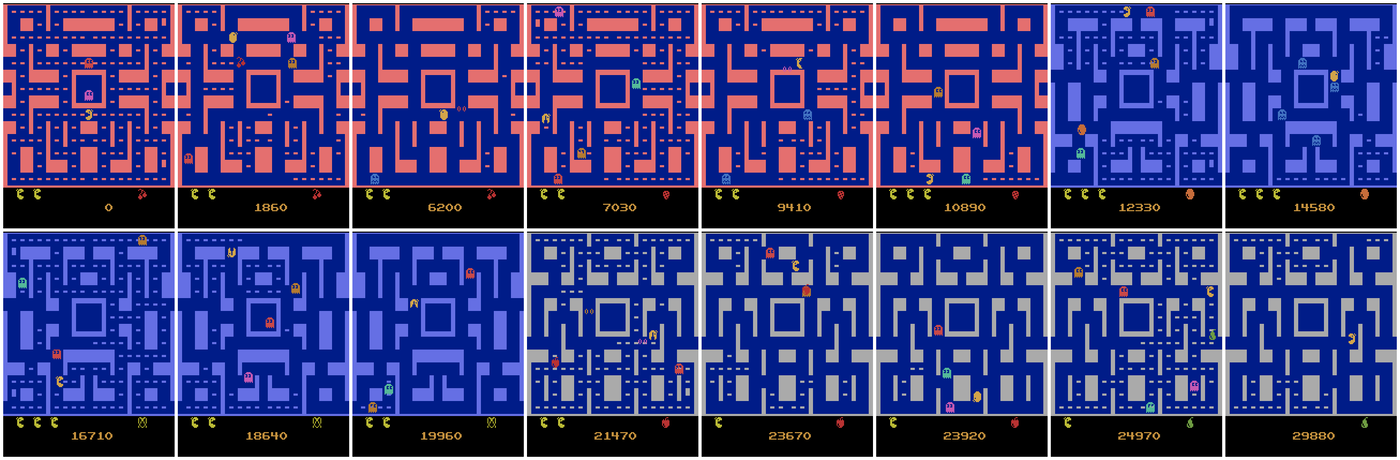
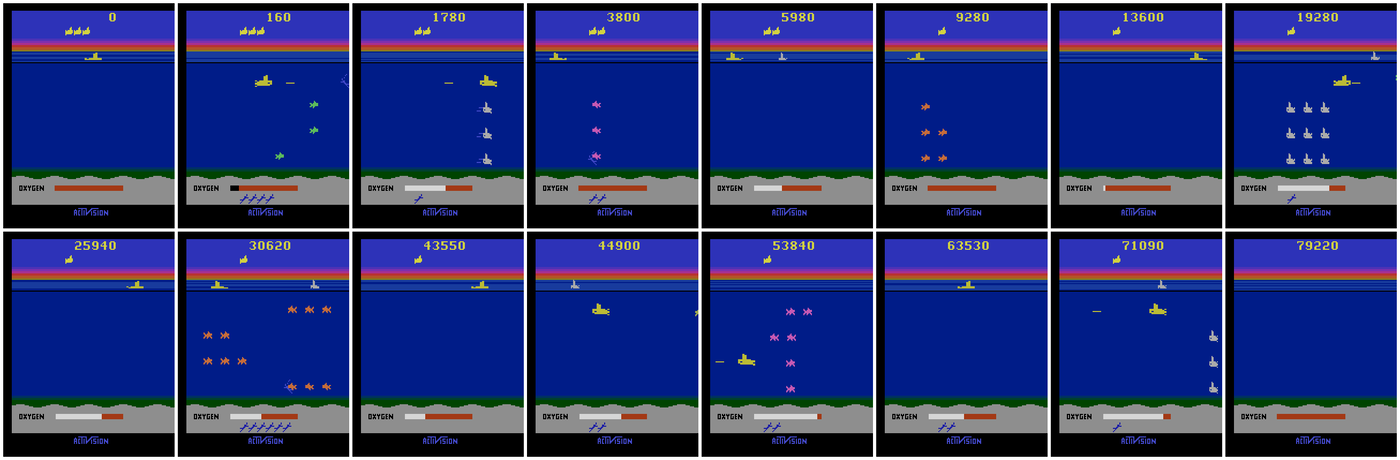
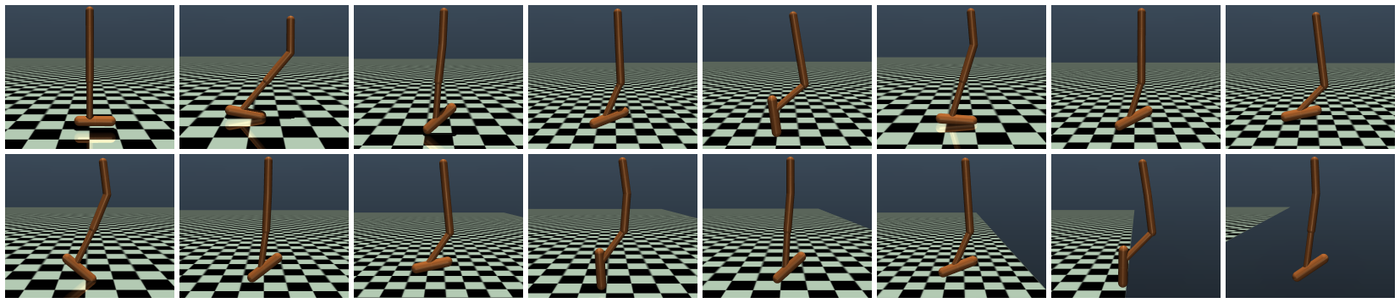
An episode from one of the highest-scoring policies per task, with authoring model and held-out score.


Full galleries cover all tasks in the paper's appendix.
| Older → newer | Improved | Tie | Regressed |
|---|---|---|---|
| Claude Fable 5 → 5.1 | 22 | 14 | 9 |
| GPT-5.6 Sol → GPT-6 Astra | 24 | 16 | 5 |
| DeepSeek V4 Pro → V4.1 Flash | 34 | 3 | 4 |
| Gemini 3.5 Flash → 3.6 Flash | 16 | 10 | 15 |
| Model | Rank interval | z mean | z interval | Percentile | Percentile interval |
|---|---|---|---|---|---|
| Fugu Ultra | [1, 4] | +0.776 | [+0.59, +0.96] | 77.2 | [72.2, 82.2] |
| GPT-6 Astra | [1, 4] | +0.745 | [+0.56, +0.93] | 78.8 | [73.9, 83.7] |
| Fugu | [1, 8] | +0.587 | [+0.40, +0.77] | 69.8 | [64.8, 74.8] |
| Claude Fable 5.1 | [2, 9] | +0.572 | [+0.39, +0.75] | 67.3 | [62.4, 72.1] |
| GPT-5.6 Sol | [3, 13] | +0.441 | [+0.26, +0.62] | 68.4 | [63.5, 73.3] |
| Claude Fable 5 | [3, 14] | +0.428 | [+0.25, +0.61] | 65.5 | [60.7, 70.4] |
Both through Codex at high reasoning, same 30-minute budget and 12-attempt target. Excluded from the primary comparison because the mechanism differs.
Fugu: Unlock Pickup, Pursuit (Prey), Clean Up. Fugu Ultra: Core War, Prisoner's Dilemma, Beach. Advantages may be task-dependent.
Fugu's cost is unavailable (selected model undisclosed); Fugu Ultra's omits orchestration tokens and is a lower bound.
Library defaults, not the Zoo's tuned Hopper entry.
Changes follow the RL Baselines3 Zoo Humanoid entry.
| Benchmark (metric) | Shared | τb |
|---|---|---|
| SEC-bench Pro (Pass@1) | 5 | +0.800 |
| Agents' Last Exam (Score) | 15 | +0.600 |
| ExploitGym (Pass@1) | 6 | +0.600 |
| ALE-Bench (mean perf.) | 37 | +0.570 |
| ProgramBench (Almost@1) | 8 | +0.500 |
| Terminal-Bench 4.0 | 12 | +0.485 |
| Terminal-Bench 3.0 | 11 | +0.455 |
| DeepSWE v1.1 | 20 | +0.400 |
| Chartography (no tools) | 22 | +0.399 |
| CyberGym | 13 | +0.348 |
| ZeroBench-main (Pass@5, tools) | 9 | +0.333 |
| AutomationBench (public) | 10 | +0.289 |
| Terminal-Bench 2.1 | 23 | +0.258 |
| BabyVision | 7 | +0.238 |
| NL2Repo-Bench | 13 | +0.026 |
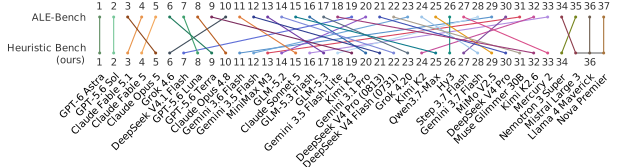
Rankings broadly agree, with many fine-grained differences.
At least 5 shared models, matched by registry identifier; scores reused as-is (highest listed, disputed variants excluded); lower-is-better metrics reversed. Descriptive agreement in model ordering, limited by overlap, harnesses, reasoning settings, and score sources.